
The Small Fleet Problem
Most car rental management software is designed for enterprise fleets — 50+ vehicles, airport operations, corporate accounts. The interface assumes you have a dedicated fleet manager, a reservations team, and an IT department.
If you run 5 to 30 cars, you are none of those things. You are the owner, the fleet manager, the customer service team, and often the person driving the car to meet a client who couldn't find the pickup location.
The software built for your scale either doesn't exist or costs €200–400/month with features you'll never use. The result: most small fleet operators manage on spreadsheets, WhatsApp groups, and paper logs — until the problems compound into something that costs real money.
What Manual Fleet Management Actually Costs
Let's break down the actual cost, not the abstract one.
Missed bookings from slow response times. A customer who messages asking about a car for the weekend and doesn't get a response within a few hours has already moved to the next option. Tourism industry data from the Philippine Department of Tourism and international booking platform studies consistently show that 60–70% of vehicle rental decisions are made within 24 hours of the search — and a significant portion within 2 hours.
If you're sleeping, driving, or in a meeting when the message comes in, the booking is gone.
Double bookings. Two customers booked for the same car on overlapping dates. This happens when availability isn't tracked in a single source of truth. It typically costs you one booking (you honor one and refund the other), one angry customer, and reputational damage that's difficult to quantify.
No-deposit no-shows. A customer who confirmed over WhatsApp but hasn't paid hasn't actually committed. No-show rates for undeposited reservations run 15–25% for short-term vehicle rentals, based on operator interviews conducted as part of the Skaly onboarding process with 14 Philippines-based rental businesses.
Admin overhead. Even a small fleet of 10 cars requires 1–2 hours of daily coordination: checking the calendar, confirming pickups, chasing payments, updating availability. Over a year, that's 365–730 hours — time that could be spent growing the operation.
What Purpose-Built Fleet Management Software Does
A custom car rental system built for your operation removes the manual steps without removing your control.
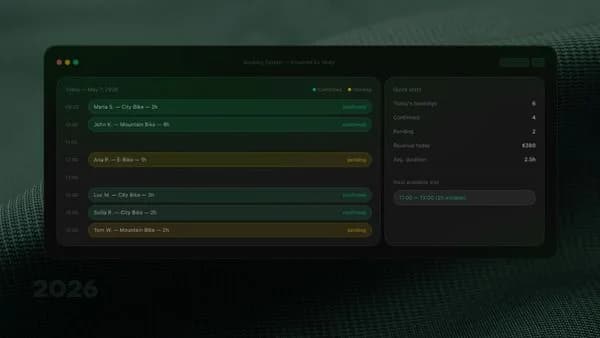
Real-Time Availability Calendar
Every vehicle has its own availability calendar, visible to customers in real time. When a car is booked, it's blocked across all channels. Double bookings become technically impossible.
Customers browse your fleet, see which cars are available for their dates, and book directly — no message, no waiting, no missed opportunity.
Deposit at Booking
The single most effective no-show prevention tool for vehicle rentals is requiring a deposit at booking. When a customer has paid 20–30% of the rental cost upfront through GCash, Maya, Stripe, or PayPal, the no-show rate drops dramatically.
The system collects the deposit automatically at the time of booking. The remainder is charged at pickup (or fully at booking, depending on your preference). Cancellations within your policy window trigger automatic refunds. No manual chasing.
Fleet Status Dashboard
Your admin panel shows every vehicle at a glance:
- Available — currently unbooked for the period
- Rented — out with a customer, return date visible
- Due back today — so you're never surprised
- In maintenance — blocked from bookings until cleared
When a car comes back with damage, you log it in the dashboard, mark it for service, and it's automatically removed from available inventory. When it's cleared, you unblock it — it's immediately bookable again.
Customer Database
Every renter's full history is stored: ID documents (uploaded at booking), past rentals, payment records, and any notes your team adds. Returning customers don't have to re-submit documentation. Corporate clients who rent regularly get a profile showing their entire history with you.
Revenue Reporting
Daily, weekly, and monthly revenue breakdowns by vehicle, by rental type, and by customer segment. Know which cars are your highest earners, which spend too much time in maintenance, and which rental durations are most profitable.
The Difference Between GCash and Paper
For operators in the Philippines specifically, the payment integration matters as much as the booking flow. GCash is the dominant payment channel for consumer transactions — a booking system that can't process GCash creates friction that leads to abandonment.
A properly integrated system connects directly to GCash, Maya, and PayPal. Payment confirmation happens instantly at booking. Funds go directly to your registered account. The invoice is generated and sent automatically — no manual bank check, no "I'll send the GCash receipt" back-and-forth.
The Economics
| Metric | Manual operation | With Skaly system |
|---|---|---|
| Booking availability | When you reply | 24/7 |
| Double bookings | Occasional | Zero |
| No-show rate (no deposit) | 15–25% | ~5% |
| Daily admin time | 60–120 min | 10–15 min |
| Revenue tracking | Estimate | Real time |
| System cost | — | ₱5,499/year |
For a 10-car fleet averaging ₱1,200/day per vehicle at 60% occupancy, reducing no-shows from 20% to 5% recovers approximately ₱328,500/year. The system costs ₱5,499/year (approximately ₱5,500).
See what a system built specifically for your fleet looks like: Rental & Fleet Management System →